





Bengal Polls: Old Loyalties for Left Resurface in Mahananda Plains
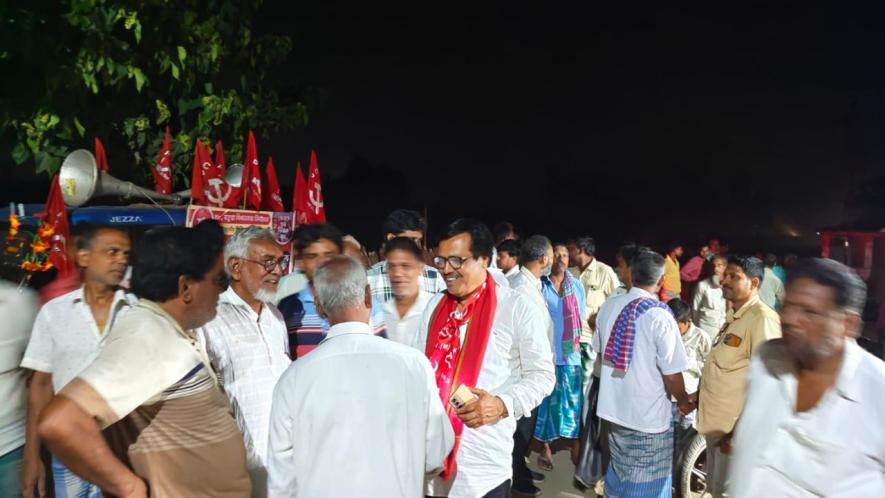
Malda, West Bengal: The Mahananda river moves through the northern reaches of Malda district with slow, indifferent patience, It has too much — floods that swallowed villages, droughts that cracked the earth, governments that came with promises. The plains the river waters have known many political colours over the decades. These seem to be turning red again, as Bengal goes into phase-1 of the Assembly polls on April 23.
Across three Assembly segments — Ratua, Manikchak and Harischandrapur — something is happening that television studios or social media timelines of political correspondents have failed to capture. What is happening is visible at crossroads, in tea stalls, on the painted walls of houses. The hammer and sickle (the CPI(M)’s election symbol) is back — not as nostalgia, not as sentiment, but as a living argument: that there is a politics beyond corruption and beyond communalism.
Ratua: Old Men's Last Wish
The mango orchards of Ratua are suffering this season. The mukul — the tender blossom -- is scorched by a heatwave that has arrived earlier than usual. Standing at the edge of one such orchard, 37 kilometres from Malda town, one understands something about this belt: everything here is contingent. The harvest may or may not happen. Jobs may or may not materialise. Government schemes may arrive at your doorstep or may not, as often happens.
Mohd. Illiyas pulls a cart for a living and has been staying under a thatched roof his entire life. Not for want of a government scheme — the Pradhan Mantri Awas Yojana, theoretically, was for people like him. But the money, he tells NewsClick, has gone to those who can afford to pay “cut money” (commission) that the ruling Trinamool Congress's (TMC) local apparatus treats like a toll.
"Rich people got the housing money," he said, standing outside the Ratua area committee office. He said he would vote for CPI(M) candidate Jahur Alam, adding that he will do more than vote, he will campaign "all out."
Alam is first known in Ratua as ‘Master’, a title for Bengali schoolteachers, and then as the CPI(M)'s area committee secretary for three consecutive terms before 2021. These are the years, he spent walking these lanes the way he walks even now — knowing everyone by name, knowing their needs, which household lost a son to a construction accident in Surat, and which family is still waiting for a land title promised in 2016.
Alam tells the team of reporters the story of the eight old men.
On the day of his nomination rally, as the procession moved through the streets of Ratua, his phone rang. A voice from a distant village said: “We want to come. Don't send vehicles. We will come on our own. Just say yes.”
A battered Sumo SUV pulled up soon and eight men climbed out. All above 80 years old. Four of them Haji sahebs — men who had completed the pilgrimage to Mecca, men who carry in this community, the weight of a lifetime's faith and standing. Their eyes, he said, were moist.
"This is probably our last election. Our last desire is to see the red flag flying over Ratua again. That is our final wish, before death," they told Alam.
An emotional Alam said he did not try to stop them. A man who has spent a lifetime in the political trenches — who has swallowed defeats, watched what was built get dismantled — was undone by the image of those eight old men arranging their own transport to deliver their final wish to a Left Front candidate.
The TMC's counter-campaign is working a familiar lever: fear. Oleida Bibi, 35, who has been canvassing for Alam, said: "They go around telling people that Kanyashree, Yuvashree, all the money transfer schemes will be shut down if the Left wins." This is a poll strategy — TMC is weaponising even the small mercies of patronage politics, ensuring that the beneficiary of the dole remains, always, slightly afraid of the hand that gives it, she said.
But Mrinmoy Haldar, who runs a grocery shop in Ratua town, thinks that this weapon is blunting. "Alam is the candidate of all communities," he said, adding "Hindi-speaking traders, Marwari merchants are all moved by his speeches”.
Manikchak: Simplicity as Honesty
The road to Manikchak, 30 km from the district town, winds through flat alluvial land where the April sun is already leaching the colour from the mustard fields. There are no large industries here, no significant landmarks, no reason for the political commentariat of Kolkata to pause here unless an election forces their hand.
But the Ganga river pauses here — or rather, it does not pause at all, and that is the problem. It gnaws at the riverbanks, swallowing villages one metre at a time. The people it displaces do not make news. They are absorbed into the migration statistics, boarding trains to Gujarat, Kerala and Tamil Nadu, joining the army of invisible Bengali labourers.
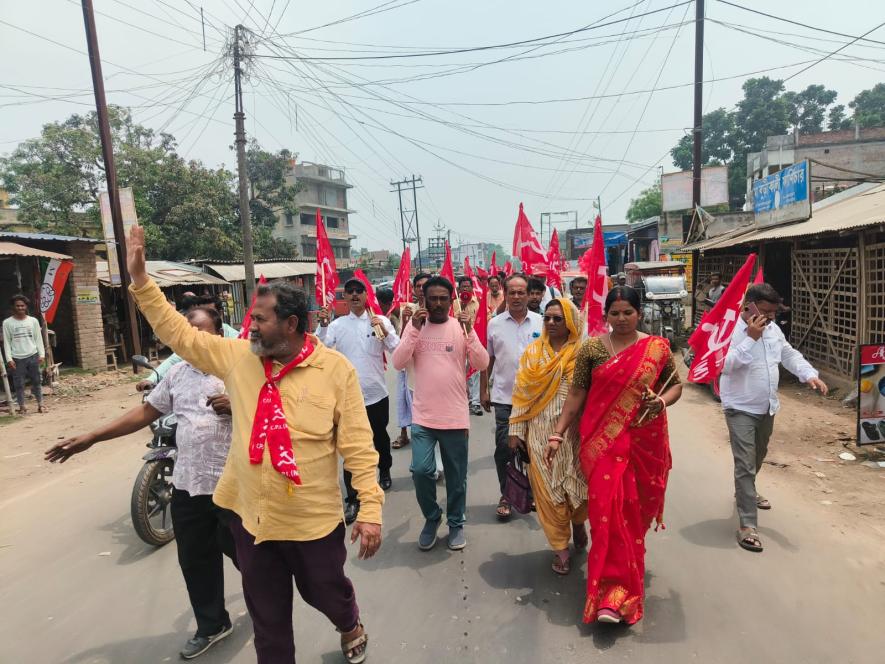
It is against this backdrop that Debajyoti Sinha of CPI(M) is running his campaign — not with grand promises, but modesty. “Restore the rule of law. Ensure at least one earning member per household has employment. Revive SSC examinations, mired in corruption scandals, so that a young person from Manikchak can compete fairly for a government job rather than pay a bribe or surrender to despair,” he says.
There are "simple promises," Sinha tells us during a door-to-door round at Shekhpara. But in a district where the only alternatives are BJP's communal mobilisation and TMC's transactional dole politics, simplicity is a scarce commodity.
Sinha’s credibility is known. During the Covid lockdowns, when migrant workers were stranded without wages or food in distant states, it was the CPI(M) that organised to bring people home, sustain families, filled the gap that the State had vacated. When the river Ganga consumed another village and the rehabilitation promises vanished into the bureaucratic distance, the party fought in the courts and on the streets. When voters' names began disappearing from electoral rolls in constituencies the ruling party found inconvenient — those systematic deletions that have become a signature of TMC's electoral management — the party made a public stand, he says.
The numbers are moving, Sinha says. In the last Lok Sabha election, Congress leader Isha Khan Choudhury, contesting in the Left alliance, won convincingly, drawing a substantial lead from this very segment. Since 2018, the BJP's vote share has fallen by 7.5 percentage points. "People are saying that the party which has fought alongside them must now win," he said.
Among those who agree is Professor Santanu Jha of Bidhan Chandra Agricultural University, who has returned to Manikchak, his ancestral home, to vote. He said he found the campaign's energy “so moving” that he joined the team. "West Bengal's education scenario is pathetic," he said. “The SSC scandal, the politicisation of appointments, the collapse of quality in rural schools — it is all connected to the same governance failure. Only a change can protect ordinary people," he added.
Then he said something that stayed with us: "The tragedy is that children here are dropping out before they finish school. Not because their families don't want education for them — but because the family cannot survive without them earning. At the age of 15-16 years, they board trains to Surat and Hyderabad."
Sadik Sheikh, a 30-year-old schoolteacher from Manikchak, had a finer, more personal, take. "There is not a single month without a death notice," he said. "A construction accident in Chennai. A factory fire in Punjab. These are our boys."
He spoke of the double pressure on the district's Muslim minority — caught between BJP’s communalism and TMC's patronage machinery.
Harischandrapur: When an MP Said ‘You Have No Rights’
No incident in recent weeks has illustrated the communal stakes in this Assembly election more starkly than what happened in the days around Nababarsha — Bengali New Year, April 15 — in Harischandrapur.
As many as 17 men from the Bhangal Gram Panchayat area — all from minority backgrounds, all vendors who made their living travelling to the Belagutha region of Odisha — were apprehended by police after being beaten by locals who accused them of being Bangladeshis. Their crime was speaking Bengali among themselves. Even after they produced their Aadhaar cards — the document the Indian State has elevated to the status of ultimate proof of citizenship — they were not released.
Their desperate families approached the local BJP MP, Khagen Murmu, for intervention. The response they received — as recounted by Manaora Bibi, wife of one of the detained men — was reportedly that they had no right to ply their trade in a "Hindu state" of Odisha.
The TMC, with its characteristic instinct for protecting its own political flanks by maintaining silence on communal provocations, said nothing, they said.
The only political figure who moved was SK Khalil, the CPI(M) candidate for Harischandrapur. He pressured the local police station to contact their counterparts in Odisha, and the men were eventually released.
Walking through Bhaluka and Daulatpur in the Harischandrapur segment, you see wall writing "Cast your vote in favour of SK Khalil" in lane after lane. The other parties' slogans are sparse, faded, or simply absent.
Manaora Bibi is not a political figure. Her husband was beaten and detained for speaking his mother tongue. She was turned away by an MP when she sought help. Her verdict is clear.
"Those who spread hatred between Hindus and Muslims will be defeated," she said, adding "What is written on these walls will come true."
The Larger Picture
The BJP has, in this belt, attempted two things simultaneously: to get Muslim voters deleted from the electoral rolls through SIR, and to use religious functions and festivals to harden communal divisions. These are not separate strategies; this is the same strategy, operating at different registers. Illiyas in Ratua said: "They have made nearly 50,000 Muslim voters of this Assembly segment into non-voters. And they are using religious functions to set Hindus against the other community."
Local resident said that TMC, for its part, has mastered the art of “extracting compliance from poverty — making welfare schemes a lever of political loyalty, ensuring that the poor remain grateful and afraid in equal measure. The cut money economy is not an aberration of the TMC's rule; it is, in these districts, its operating architecture.”
Between these two poles, the Left Front is offering a politics of class solidarity that cuts across religious lines, a campaign that showed up when the flood came and when the migrant died, when voter names were erased and when the arrested vendors help.
Whether this is enough to win, only the counting day on May 4 will show. For, as much as old loyalties are hard to shift, fear is a durable political tool.
Get the latest reports & analysis with people's perspective on Protests, movements & deep analytical videos, discussions of the current affairs in your Telegram app. Subscribe to NewsClick's Telegram channel & get Real-Time updates on stories, as they get published on our website.