





Bengal: Between Tides and Turmoil,State's Largest Fishing Communities Struggles to Stay Afloat
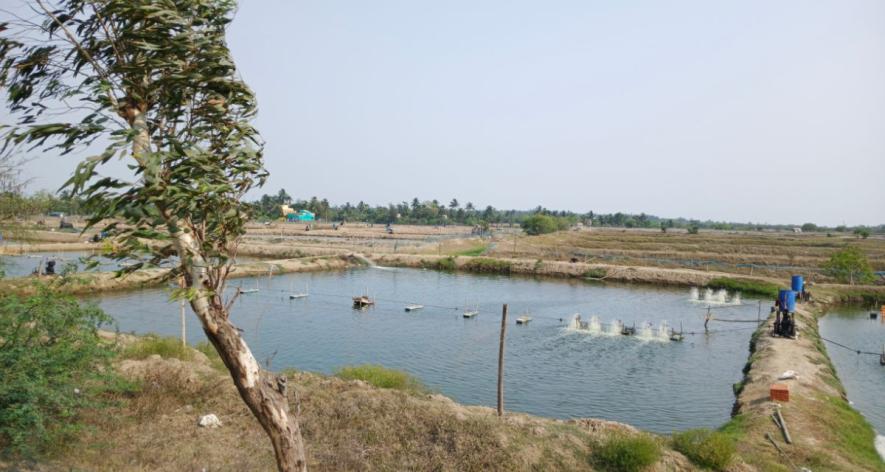
India imposes seasonal fishing bans to protect fish breeding cycles, though policies differ by state, sometimes sparking concerns about fairness for small-scale fishers (Photo - Sagnik Majumder, 101Reporters).
Midnapur, West Bengal: “So many of our brothers have left the sea,” said Srikant Das, 69, a small-scale fishworker from Contai in East Midnapore district. “They now work as daily wage labourers. Our fishermen’s organisation used to have 5,000 members. Today, only around 3,700 remain. Some who once owned their boats are now working on the very trawlers they once opposed. That’s what desperation does…it breaks your pride.”
On a hot May morning in Contai, many fishworkers could be found idling in their homes. Most had no work, while some had taken up daily-wage labour in construction or agriculture. Contai—also known as Kanthi—is a coastal subdivision in Purba Medinipur district along the Bay of Bengal, where fishing has been passed down through generations. Today, the community is struggling to survive amid fishing bans, shrinking catches, climate stress and rising debt.
Srikant, who is also the chairman of the Maa Kali Fishermen Association, affiliated to the Dadan Patrabah Matsya Khati, said the bans have left small-scale fishworkers without a steady source of income, forcing many to migrate out of the district.
Why fishing bans exists
India enforces a uniform fishing ban every year to protect breeding fish stocks. On the east coast, including the Bay of Bengal, the ban lasts 61 days from April 15 to June 14 within India’s Exclusive Economic Zone. Coastal states also impose bans within their territorial waters during this period, according to orders issued by the Union government.
While mechanised boats are banned across India during the spawning season, traditional and non-mechanised boats are typically exempted because of their relatively minimal ecological impact. West Bengal is the only coastal state that extends the ban to include small-scale traditional fishers operating within 12 nautical miles. Fishworkers allege that this decision benefits large trawling interests, though the state government has not publicly explained the rationale.
Pradip Kumar Chatterjee, president of the National Federation of Small Scale Fish Workers, said the distinction between mechanised and traditional boats is crucial. “While the central government enforces a blanket ban within its jurisdiction, it allows states to frame rules for territorial waters,” he said. “Across the country, mechanised boats are prohibited during spawning season, but traditional fishers are allowed to operate. West Bengal is the only state that has shut out small-scale fishers as well.”
According to Chatterjee, nearshore waters, between zero and 100 metres from the coast, are witnessing rapid depletion of fish populations. “Ironically, this is also the zone that yields the maximum catch,” he said. “Small-scale fishers depend on it, but they now compete with mechanised boats that haul in nearly 82% of the total catch.”
Two sides of the coin
Despite the hardship it causes, Srikant says he does not oppose the ban itself.
“Fishing bans have to be there,” he said. “If fish populations are to bounce back, trawling must be brought under control. These trawlers don’t just fish—they claw through the seabed, destroying the very ecosystem the bans are meant to protect.”
Srikant has been fishing since he was 16. He began as a labourer on his father’s boat and now owns his own vessel. Over more than five decades, he has witnessed multiple iterations of the ban and believes it is ecologically necessary.
“Everyone you see here…every calloused hand, every sun-darkened face…is a fisherman who inherited this life from his father, and his father before him,” he said. “Fishing is all we’ve ever known. It’s our craft, our culture, and our only means of survival. We don’t have land or shops, or salaries. We have boats and nets.”
Yet even those who support the ban are deeply anxious about its economic impact.
Kalpana Mondal, a fishworker from Contai, said declining catches have pushed families into unsustainable debt. “There are not as many fish in the sea as there used to be,” she said. “Without ample catch, we can’t repay loans. The two-month ban forces us to work as labourers. There are five people in my family, and it costs us around Rs 15,000 a month just to survive.”
She added that the promised compensation of Rs 5,000 during the ban has not reached fishworkers. “Even that amount feels like a myth now,” she said. “And why is only the man promised this money? Don’t my efforts matter because I’m a woman?”
Mamoni Pradhan shared a similar story. Her husband, Khokhon Pradhan, once known locally for his skill as a fisherman, now works as a daily labourer. “We don’t own any land,” she said. “Fishing was all we had. We even tried growing watermelons, but the chemicals alone cost Rs 800 to Rs 1,000. Nothing works.”
Khokhon said borrowing money from mahajans, or informal moneylenders, has become unavoidable. “If I borrow Rs 6 lakh, I have to sell my entire catch to him at a price he decides,” he said. “There’s no interest, but there’s no freedom either.”
Collapsing ecosystems
Marine scientists say fishing bans alone cannot address the crisis facing coastal fisheries.
Dr R Venkatesan, former head of Ocean Observation Systems at the National Institute of Ocean Technology, said climate change has significantly accelerated marine degradation. “In addition to trawlers destroying seabeds, ocean warming and acidification are major factors,” he said. “They severely affect marine organisms with exoskeletons, such as crabs, lobsters and corals.”
Cyclones, he added, worsen the situation by churning fish into deeper waters and disrupting ocean currents. “Brooder fish, those carrying eggs, are especially vulnerable to temperature changes,” he said. “When they die during spawning, the entire food web is affected.”
Ranjit Bar, a small-scale fishworker from the Jele community, believes marine protection measures need to be stronger—but also fairer. “The baby fish are being killed before they mature,” he said. “That’s why we can’t survive.”
His wife, Jyotsna Bar, described how families cope during the ban. “Fishing is never a one-person job,” she said. “During the ban, men work as masons or labourers. Women clean houses or work in fields. After a full day, a woman earns barely Rs 200.”
She added that mechanised boats cause far greater damage than traditional fishing. “If the ban on trawlers were extended, maybe the sea could recover,” she said.
Ranjit also pointed to industrial pollution. “When venomous prawns are processed for export, waste water is dumped into canals,” he said. “The next day, dead fish float on the surface. We are dying alongside the sea.”
Forced migration
To offset income loss during the ban, fishworkers were earlier covered under the savings-cum-relief scheme, which provided Rs 3,000 per worker, jointly funded by the Centre and states. West Bengal discontinued the scheme in 2015 without introducing an alternative.
After years of protests, the state government announced the Samudra Sathi scheme in its 2024–25 budget, promising Rs 5,000 per month for two months to registered fishermen and allocating Rs 200 crore for the programme.
The scheme was never implemented.
An RTI filed by Debasis Shyamal, president of the Dakshinbanga Matsyajibi Forum, revealed that no funds had been released for Samudra Sathi. Fishworkers say the delay has forced many to migrate.
Dr Shilpa Nandy, associate professor at Khudiram Bose Central College, said migration has intensified since Covid-19. “Fishworkers from East Midnapore and South 24 Parganas are migrating to Kerala for work,” she said. “Women and children are often left behind, increasing vulnerability to debt and exploitation.”
A March 2024 notification from the state fisheries department stated that only one ‘fisherman’ per family would be eligible for compensation.
“That word matters,” Kalpana said. “Fishing is shared labour. Excluding women erases our work.”
Even the men, she added, have not received the promised money.
Fishworkers say repeated attempts to engage the West Bengal fisheries department have failed. The department did not respond to requests for comment for this story.
As another ban season approaches, communities along the coast brace for another year of uncertainty.
“We protect the sea because it is our life,” Srikant said. “But if we are not protected in return, how long can we survive?”
Sagnik Majumder is a freelance journalist and a member of 101Reporters, a pan-India network of grassroots reporters.
Get the latest reports & analysis with people's perspective on Protests, movements & deep analytical videos, discussions of the current affairs in your Telegram app. Subscribe to NewsClick's Telegram channel & get Real-Time updates on stories, as they get published on our website.