





Bengal After Trinamool: Political Economy of a Collapse
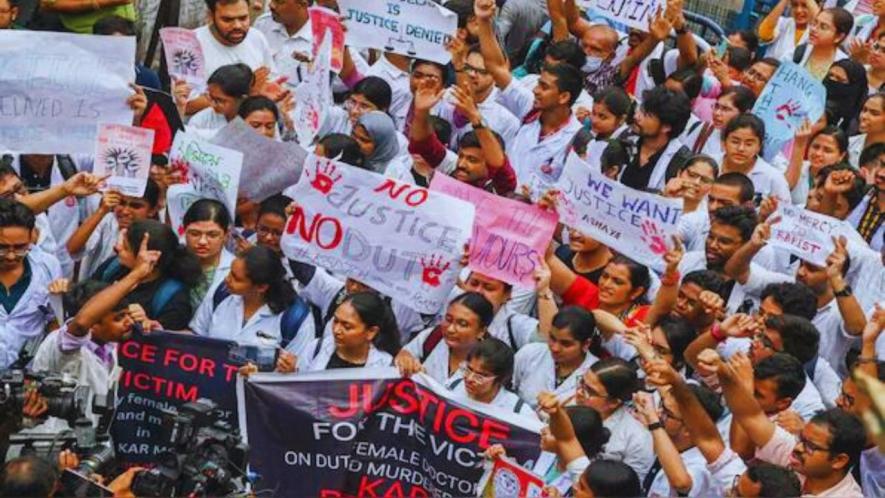
Image Courtesy: PTI
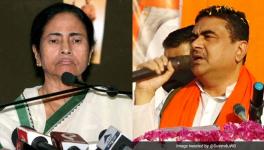
When the results of the West Bengal Assembly election were declared on May 4, 2026, much of the national commentariat reached for a familiar frame: a personality story, the rise and fall of Mamata Banerjee, a morality tale about one leader's hubris. There is truth in that frame, but it is also a convenient one, because it allows the deeper story to go untold — the story of how, for 15 years, West Bengal was governed by a political formation that represented no class interest except that of capital in its most parasitic, rent-extracting forms, dressed in the language of the poor. And and how that formation's collapse has now handed the state to the Bharatiya Janata Party (BJP), the most organised vehicle of Hindutva and corporate consolidation that Indian politics has produced.
To understand what just happened in Bengal, it is necessary to go back to what the Trinamool Congress (TMC) actually was — not as a cult of personality, though it was certainly that too, but as a political-economic project. And to understand that, one has to start with what it replaced.
What the Left Front Built, and What Replaced It
For 34 years, the Left Front government in West Bengal carried out the most far-reaching land reform programme: Operation Barga gave sharecroppers recorded rights over the land they tilled, redistribution broke up the largest holdings, and a functioning three-tier panchayat system devolved real power — and real budgets — to elected bodies at the village level. This was not a perfect record, and the Left Front's own missteps, particularly its turn toward forced land acquisition for industry in the mid-2000s, opened the door for everything that followed. But it is important to be clear about what was actually lost when that government fell in 2011, because the TMC's entire subsequent narrative depends on nobody remembering it.
What replaced the Left Front was not a more progressive alternative. It was a coalition assembled, opportunistically, from every force that had a grievance against the Left Front government — some with legitimate grievances rooted in the Singur and Nandigram land acquisitions, others with grievances rooted in something closer to their opposite: landlords and rural elites whose interests Operation Barga had curtailed, real estate and construction capital that found the Left Front's regulatory apparatus inconvenient, and a layer of rural strongmen who saw, in the breakdown of Left Front discipline, an opportunity to build their own local fiefdoms. The TMC's genius — if that is the word — was in holding this coalition together under a single populist banner, "Maa, Mati, Manush," while delivering, in practice, almost nothing to the actual peasantry and rural poor that the slogan invoked.
The Class Character of Trinamool
It has become fashionable to describe the TMC as having "no ideology," and there is a sense in which that is true: it never produced a programme document, never articulated a position on land, industry, or labour that it held consistently for more than an electoral cycle. But "no ideology" is itself a kind of ideology — it is the ideology of capital that does not want to be governed by any rules at all, that prefers a state which can be approached transactionally, deal by deal, rather than one bound by policy.
This is the thread that runs through the TMC's entire history in government, from the appointment of Amit Mitra — formerly Secretary General of the Federation of Indian Chambers of Commerce and Industry, India's most powerful corporate lobby, and a public advocate for retail FDI and the deregulation of fuel prices — as Finance and Industry Minister, to the systematic dismantling of trade union activity in the state's remaining industrial belts, to the return of factory lockouts with police protection for management rather than workers. None of this required a manifesto. It only required a government willing to let capital operate without the friction of organised labour or regulatory oversight — and willing, in exchange, to extract its own cut through a parallel economy of "syndicates."
That parallel economy deserves to be named for what it was: a mechanism of primitive accumulation, in which party functionaries inserted themselves as gatekeepers — over construction material, over small business licensing, over local infrastructure contracts — and extracted a toll from the petty-bourgeois and working-class people who had to pass through that gate to make a living. This was not a deviation from TMC governance. For millions of people in Bengal's towns and peri-urban areas, the "syndicate" was the most direct daily experience of what TMC rule actually meant.
The Sangh Parivar Link: A History TMC Would Rather Forget
If there is one part of this story that the TMC's current self-presentation — as Bengal's last secular bulwark against Hindutva — depends most heavily on erasing, it is the party's own history of collaboration with the Sangh Parivar. After breaking from Congress in 1998, Banerjee joined the BJP-led NDA, served in the Atal Bihari Vajpayee cabinet, and in September 2003 addressed an RSS (rashtriya Swayamsevak Sangh) gathering in Delhi, praising the organisation as a body of "true patriots" engaged in a "fight against communists" — language for which RSS leaders reportedly hailed her as "saakshat Durga." Through the late 1990s and early 2000s, TMC alliances with the BJP extended across Lok Sabha, Assembly, panchayat, and municipal contests in Bengal.
This history matters for a reason that goes beyond hypocrisy, though it is certainly that. It matters because it was the TMC, not the BJP acting alone, that did the work of normalising Hindutva politics as a legitimate participant in Bengal's electoral landscape — a state that had, for decades, kept communal politics on the margins. Every subsequent BJP gain in Bengal, including the 2026 sweep, was built on a foundation that the TMC itself helped lay, brick by electoral alliance, two decades earlier, purely in pursuit of ministerial office in Delhi. When TMC leaders now warn voters that a BJP government represents an existential communal threat to Bengal, they are not wrong about the threat — but they are concealing their own role in making that threat electorally viable in the first place.
Singur, Nandigram, and the Forces That Gathered
The Singur and Nandigram agitations of 2006–2008 are remembered, in mainstream accounts, as a popular uprising against forced land acquisition — and there was real, justified anger in both places that deserves to be taken seriously on its own terms. But the political coalition that formed around that anger was not a coalition of the peasantry alone, and it is worth being precise about who else was in the room.
Maoist cadres, operating in the Jangal Mahal districts, found in the TMC a useful ally against a common enemy — and the alliance went well beyond rhetorical convergence. Investigations later attributed 245 deaths of CPI(M) workers and civilians in Jangal Mahal to this TMC-Maoist nexus, and the relationship reached its most extreme point on November 2, 2008, when an assassination attempt on sitting Chief Minister Buddhadeb Bhattacharya at Salboni was met, from sections of the TMC leadership, not with condemnation but with statements that read, in retrospect, as closer to satisfaction.
Maoist commander Kishenji publicly endorsed Banerjee for the Chief Minister's post in an interview published in October 2009, and again ahead of a Lalgarh rally in August 2010 — open collaboration between a mainstream party holding ministerial office at the Centre and an organisation the same Central government had designated the country's gravest internal security threat.
A parallel pattern unfolded in North Bengal with the Kamtapur Liberation Organisation, whose cadres had killed more than 60 CPI(M) workers, including five shot dead at a party office in Dhupguri in August 2002. When the TMC took power in 2011, KLO chief Tom Adhikari and several senior associates were released from custody, vanishing underground within months, with KLO operatives again under suspicion in a 2013 bombing.
Religious fundamentalist organisations and foreign-funded NGOs — the latter a category that deserves scrutiny rather than the automatic benefit of the doubt that "civil society" branding often receives — also found common cause with the TMC during this period, for the same reason the Maoists did: not because they shared an analysis of land policy, but because they shared an enemy. Once that enemy was removed from power in 2011, every one of these alliances was discarded. The Maoist label was redirected at the TMC's own critics. The KLO leaders went back underground. The NGOs moved on to other causes. What remained was the TMC, now in government, having drawn on every reactionary current available to it on the way up, and having no further use for any of them on the way down.
Saradha, Narada, and Financialisation of Politics
The Saradha chit fund collapse of April 2013 is usually narrated as a corruption scandal — and it was that, on a staggering scale: roughly 1,700 companies under the Saradha umbrella extracted more than ₹2 lakh crore from more than one crore depositors, the overwhelming majority of them working people putting aside small savings. But it should also be read as something more structural: an example of what happens when a state government's relationship to capital is organised entirely around informal, personalised channels rather than regulated ones.
Saradha's promoter, Sudipta Sen, built ties with the TMC from 2009 onward, and a month before Banerjee became Chief Minister in 2011, he purchased paintings attributed to her for roughly ₹1.8 crore — the first of a series of such purchases, by entities later identified as shell companies, totalling more than ₹21 crore, that investigators characterised as a channel for laundering chit fund deposits into the party's finances.
In communications with the CBI, Sen described being required to make large recurring payments to TMC-linked media operations, in the explicit expectation of regulatory protection. That protection was, for years, delivered: the Union Home Ministry's warnings between 2011 and 2012, the RBI's repeated flags, and SEBI's multiple show-cause notices between 2010 and 2013 all went unanswered until the scheme collapsed under its own weight — at which point Banerjee's claim to have "known nothing" was directly contradicted by her own government's sworn court affidavit.
The Narada sting operation, in which hidden cameras recorded TMC leaders and a police official apparently accepting cash, and the later confrontation over CBI access to Kolkata's police commissioner — including the extraordinary 2018 episode in which the CBI's own headquarters were effectively occupied overnight by Delhi Police on instructions from the Central government — extended this story onto the national stage.
But for Bengal's voters, the headline figures were simpler: more than 12 lakh Saradha victims remain uncompensated, a state compensation scheme disbursed barely half of what it promised, and at least a hundred victims are reported to have died by suicide, while implicated party figures returned to public life with their standing largely intact.
This is what "financialisation without regulation, mediated by a single ruling party" looks like in practice — and it is not unique to Bengal, or to the TMC, but Bengal under the TMC offered as clear an illustration of it as any state in the country.
2021: The High-Water Mark That Wasn't
The 2021 Assembly election result — a landslide for the TMC against a BJP campaign that had thrown enormous national resources at the state — was presented, including by significant sections of the liberal commentariat outside Bengal, as a victory for secular politics against Hindutva consolidation. There was something to that framing: the BJP's defeat in 2021, after a campaign built heavily around polarisation, was not nothing.
But the result contained a detail that ought to have tempered the celebration considerably: Banerjee herself lost her own seat of Nandigram, to Suvendu Adhikari, a former TMC heavyweight who had defected to the BJP only months earlier. A landslide for the party, delivered while its leader lost her own constituency, is not the sign of a movement. It is the sign of a patronage machine — one capable of delivering votes through its local networks even as the central brand frays, but one whose loyalty to the Centre is conditional on the Centre continuing to deliver patronage in return. Machines of this kind do not have reserves of ideological loyalty to draw on when the patronage stops. They have only the machine itself, and the machine's interest in its own survival.
Within months of that 2021 result, the next chapter began — and it would be the chapter that, more than any other, exhausted whatever reserve of goodwill the TMC had left among Bengal's middle class and aspirational youth.
Cash for Jobs: The SSC Scandal as Class Betrayal
In July 2022, the Enforcement Directorate arrested Partha Chatterjee, then Commerce and Industries Minister and formerly Education Minister during a 2016 School Service Commission recruitment drive, after recovering roughly ₹28 crore in cash and a large quantity of gold from the residence of his close aide, Arpita Mukherjee. What followed was a slow-motion judicial reckoning with what courts eventually termed a "systemic fraud": tampered answer sheets, manipulated merit lists, and, by the Calcutta High Court's own count, 25,753 appointments from the 2016 cycle declared null and void in April 2024 — a ruling the Supreme Court upheld in full in April 2025, ordering those who had obtained posts fraudulently to return their salaries with interest.
It is worth dwelling on what this scandal actually represents, because it is qualitatively different from Saradha, even if the underlying logic — informal payment in exchange for access to state-mediated opportunity — is the same. Saradha defrauded depositors of their savings. The SSC scandal defrauded an entire generation of educated, unemployed young people of the one credible pathway into stable employment that a state with limited industrial growth still offered: a government teaching post. For a party whose foundational claim was that it represented "Maa, Mati, Manush" against an indifferent establishment, presiding over a scheme in which teaching jobs were allegedly sold to the highest bidder while genuinely qualified candidates from working and lower-middle-class families were shut out was not merely corruption. It was a betrayal of the precise social base the party claimed to speak for.
Sandeshkhali, RG Kar, and the Limits of "Maa, Mati, Manush"
If the SSC scandal exposed the TMC's betrayal of Bengal's aspirational youth, two events in 2024 exposed something more fundamental: the relationship between the party's local power structures and the safety of the women in whose name "Maa" — mother — sat at the head of its own slogan.
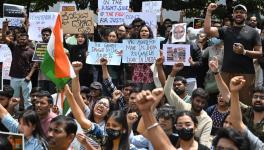
In Sandeshkhali, women came forward in early 2024 with allegations of land-grabbing and sexual coercion against a local TMC strongman and his network — a structure of local power that, by multiple accounts, had operated for years before the protests forced any state response. Months later, the rape and murder of a trainee doctor at RG Kar Medical College in Kolkata produced some of the largest protests Bengal has seen in a generation, directed not only at the crime itself but at what protesters experienced as an institutional culture of cover-up. A similar pattern recurred in 2025 with a gang rape at a Kolkata law college, where the accused had prior links to the TMC's student wing and a documented history of complaints that had gone unaddressed.
These were not isolated failures of individual policing. They were the visible surface of a governing model in which local power, exercised through party-linked strongmen, was effectively unaccountable until a crisis became too large for the state to ignore — at which point the response was performative rather than structural. By the time the 2026 campaign began, both Sandeshkhali and RG Kar had become central to the opposition's case, to the point that the mother of the RG Kar victim contested the election on a BJP ticket, citing the state government's handling of her daughter's case as her reason for entering politics. That a victim's family found the BJP — a party whose own record on communal violence and on crimes against women in states it governs is hardly exemplary — more credible on this issue than the incumbent TMC is, in itself, a measure of how completely the TMC had exhausted its claim to represent "Maa, Mati, Manush" by 2026.
The 2026 Verdict and What It Actually Means
The result declared on May 4, 2026 — the BJP crossing the two-hundred-seat mark in a 294-member Assembly, ending 15 years of TMC rule, with Suvendu Adhikari sworn in as Chief Minister — should not be read, as much of the national press has read it, as simply "Bengal turns saffron." It is that, and that alone should be cause for serious concern: the BJP's ascendancy in Bengal represents the consolidation, in one of India's largest states, of the most organised vehicle of Hindutva and corporate power in the country, a force whose record on minority rights, on press freedom, and on the rights of organised labour in the states it already governs gives no reason for optimism.
But the 2026 result is also something else: the collapse, under the weight of its own contradictions, of a 15-year experiment in governing through patronage networks, informal financial channels, and a populist slogan increasingly divorced from any material content. The TMC did not lose because Bengal's voters suddenly discovered, in 2026, facts that had been hidden from them. The Saradha scandal was public knowledge for over a decade. The Maoist alliance was reported on as it happened. The SSC verdicts were delivered by courts, in public, over years. Sandeshkhali and RG Kar played out on national television for months. What changed was not the information. It was that a model of governance built on patronage requires patronage to keep flowing — and a state with West Bengal's fiscal constraints, governing through extraction rather than production, eventually runs out of patronage to distribute, leaving only the extraction itself visible.
Within weeks of the defeat, the TMC's internal contradictions — a long-simmering divide between an older generation of district-level leaders and a more centralised operation built around Mamata Banerjee's nephew, Abhishek Banerjee — broke into open rebellion, with significant numbers of MPs and MLAs publicly challenging the leadership of both. A party held together for nearly three decades almost entirely by the personal authority of one leader, and by that leader's ability to deliver state power to her local networks, discovered in real time how little of that unity had been about anything else.
The Absence That Matters Most
What is most striking about the 2026 result, from the standpoint of anyone concerned with the actual material conditions of Bengal's working people and peasantry, is not the TMC's defeat — which, on the record above, was earned many times over — but the absence of any political force, in this election, organised around the interests of those people as a class, rather than as a vote bank to be assembled through patronage, communal appeal, or some combination of both.
The Left, whose land reform legacy remains the single most consequential redistribution of agrarian power in any major Indian state, has spent 15 years in the electoral wilderness, a casualty in no small part of its own missteps over Singur and Nandigram, but also of a media and political environment in which the only permitted choice was framed as TMC or BJP — two formations that, for all their mutual hostility, share a common commitment to a state that serves capital first and negotiates with the working population only through patronage, charity, or communal mobilisation, never through organised, collective power.
The TMC's fall is not, in itself, a victory for anyone except the BJP. What Bengal's politics needs now — and what its history, going back to Operation Barga and the panchayat reforms of the 1980s, suggests it is capable of producing again — is a political force willing to organise around the actual material interests of tenants, sharecroppers, industrial and informal workers, and the educated unemployed whose hopes the SSC scandal so comprehensively betrayed. Whether such a force re-emerges, or whether Bengal simply settles into a new equilibrium between Hindutva consolidation and whatever remains of the TMC's patronage networks, will determine far more about the state's future than the headline result of May 4, 2026 — significant as that result undeniably is.
(The views are personal.)
Get the latest reports & analysis with people's perspective on Protests, movements & deep analytical videos, discussions of the current affairs in your Telegram app. Subscribe to NewsClick's Telegram channel & get Real-Time updates on stories, as they get published on our website.