





9 Bihar Districts Have Zero PHCs Connected Under BharatNet
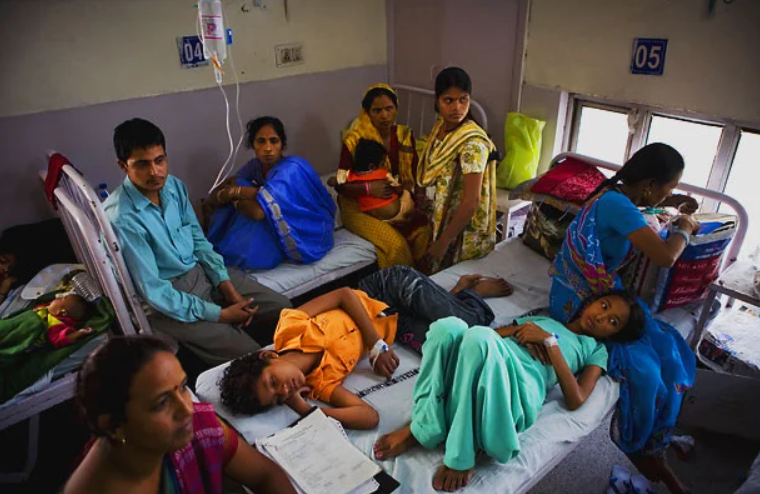
Bihar’s digital health network has a huge disparity between primary health care centres and schools, as government data says that for every one Primary Health Centre (PHC) connected with BharatNet fibre connectivity, there are close to nine secondary schools connected.
As of June 30, 2026, 1,726 government secondary schools in Bihar had active Fibre-to-the-Home (FTTH) connections under BharatNet. The corresponding number for PHCs was just 190. That is roughly a 9:1 ratio.
The sharper concern is at district level. Nine of Bihar's 38 districts had no PHC listed with an active BharatNet FTTH connection, even though government secondary schools in those districts were connected.
The widest gap appears in Madhubani, where 96 government secondary schools had active FTTH connections but not a single PHC was connected. Nawada had 29 connected schools and zero PHCs; Katihar had 21 and zero; Rohtas had 10 and zero. The other districts with zero connected PHCs were Jamui, Kaimur (Bhabua), Lakhisarai, Munger and Pashchim Champaran.
The figures come from a Lok Sabha reply by the Department of Telecommunications (DoT) on August 12. The government says the amended BharatNet programme has provided for 1.5 crore FTTH connections in gram panchayats and villages across India, including Bihar, with "priority to cover Government institutions, including Schools and Primary Health Centres."
That wording makes the Bihar figures worth a closer look. The government has not said that schools and PHCs were supposed to receive equal numbers of connections. But both are explicitly identified as priority institutions. The district-wise data shows that the rollout has not reached them evenly.
The difference matters because a PHC is often the first formal point of healthcare for people living in rural areas. Reliable internet can help health workers use telemedicine, send information to higher centres, complete digital records and communicate with specialists or district health authorities. BharatNet's own programme information lists government institutions, such as schools and hospitals among potential FTTH users.
India's digital health programme is also moving in this direction. The Ayushman Bharat Digital Mission (ABDM) is designed to allow health information to move securely between participating healthcare providers. It supports digital health records and can enable patients to access and share prescriptions, diagnostic reports and other medical information with consent.
For a patient in a remote Bihar village, this is not simply a question of faster internet. A connected PHC can become a doorway to services that may otherwise require a journey to a larger hospital. An offline PHC cannot easily take full advantage of such digital systems.
Yet, the district picture also shows that stronger PHC connectivity is possible. Madhepura has 24 connected PHCs against seven schools, while Bhagalpur has 17 PHCs, Darbhanga 16 and Khagaria 16. These districts suggest that the gap is not an unavoidable feature of the programme.
The government says ₹2,116.03 crore has been disbursed for BharatNet in Bihar. That figure covers the wider BharatNet project and should not be treated as the amount spent on PHCs. But it raises an important policy question: how much of the investment is reaching health facilities, and why are PHCs still disconnected in districts where schools have already been brought online?
The Lok Sabha reply establishes the gap. It does not explain it. Whether the reasons are rollout schedules, infrastructure problems, local implementation issues or other factors, requires further clarification from telecommunications and health authorities.
For Bihar's rural patients, that explanation matters. Digital healthcare can only work at the point where healthcare is delivered if the connection is there.
The writer is a Delhi-based freelancer who writes on health issues and medical discoveries.
Get the latest reports & analysis with people's perspective on Protests, movements & deep analytical videos, discussions of the current affairs in your Telegram app. Subscribe to NewsClick's Telegram channel & get Real-Time updates on stories, as they get published on our website.