





50 Years Since Start of Argentina’s Bloody Dictatorship
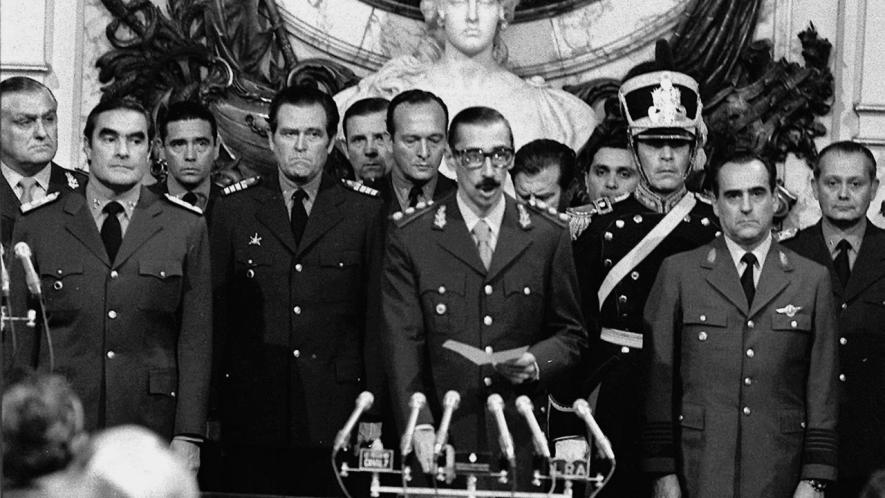
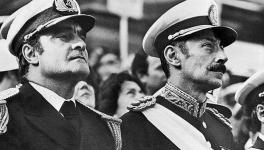
Oath of Jorge Rafael Videla as President of Argentina following the coup in 1976. Photo: Wikimedia Commons
March 24 marks the 50th anniversary of the start of one of the bloodiest and most ruthless military dictatorships in 20th-century history. In 1976, in Argentina, the leaders of the Argentine Army, supported directly and indirectly by the US government (through its military and intelligence forces), overthrew the government and ruled until December 10, 1983.
The number of murders, rapes, arbitrary detentions, and disappearances are truly horrifying. According to various reports, the figures on crimes against humanity – which are corroborated by most of the country’s and region’s most reputable historians – speak for themselves regarding the brutality of the military government:
- 30,000 disappeared;
- 15,000 murdered;
- 8,500 arbitrarily imprisoned, including priests, nuns, the elderly, people with disabilities, women, and children;
- 1,000,000 involuntarily displaced and exiled within Argentina or to other countries;
- Forced expropriation and the illegal sale of many of the victims’ properties;
- Imprisonment in concentration camps and the establishment of detention and torture sites in various parts of the country;
- Countless cases of rape, beatings, dismemberment, electrocution, etc.;
- Illegal adoption of more than 300 children born in captivity whose parents were murdered.
Historical revisionism as political justification
Although a significant portion of Argentine society views the dictatorship as a social trauma that is difficult to forget due to the brutality of the acts committed (nearly 70% of Argentines condemn the 1976 dictatorship), others have attempted to justify the need for the military government’s imposition by citing political instability. In this regard, significant attempts have been made to revise history to claim that the figures for the dictatorship’s crimes are not as high.
Currently, the figure who most questions these figures is the president, the far-right Javier Milei, according to whom, despite historical documents proving otherwise, there was no systematic plan to repress and eliminate revolutionary groups, but rather an “internal war” in which the Armed Forces committed excesses. Furthermore, Milei, true to his controversial and provocative style, claims that the actual number of disappeared persons does not exceed 9,000.
In fact, the idea that the 1976 dictatorship was a consequence of the political activity of the Argentine left has been upheld since the early days of the military government, which proclaimed itself the “National Reorganization Process”. According to these arguments, the Argentine revolutionary left was murdering, disappearing, and torturing people, leaving the Army with no alternative but to seize power and “restore order”. This is precisely the interpretation of history that Milei’s inner circle of intellectuals defends half a century later.
The origins of a bloody dictatorship
However, when one looks closely at the history of that era and subjects it to the test of time and declassified documents, the reasons are clear. Between 1973 and 1976, the phenomenon known as Peronism once again seized political power in the country. And it was precisely during this period that the bloodbath that would institutionalize the military dictatorship years later began.
It is a matter of debate whether the military officer and leader of the country’s most popular party, Juan Domingo Perón, was aware of the plans being hatched to eradicate the revolutionary left in Argentina, especially considering that a segment of that left – which would be annihilated in subsequent years – identified with Peronism, even going so far as to found its own armed movement, called the Montoneros.
Within Peronism – a heterogeneous political force rife with internal tensions (even to this day) – some factions negotiated with the wealthiest and most reactionary sectors of Argentine society. One of these was Perón’s personal secretary and, later, minister of social welfare, José López Rega, who, according to historian Sergio Guerra, also served as a CIA agent.
Following Perón’s death (after which his wife, Estela “Isabel” Martínez, succeeded him as head of government), López Rega acquired enormous power, and between 1974 and 1975, various paramilitary organizations, such as the Argentine Anticommunist Alliance (led by López Rega), murdered and disappeared more than a thousand Argentine activists and political leaders, including Montoneros militants, trade unionists from the Argentine Workers’ Central Union (CTA), and several priests who advocated Liberation Theology (among them, the renowned priest Carlos Mugica).
During those years, thousands of people were fired from their jobs, both in the public and private sectors, as was the case with hundreds of university professors who were forced to leave their positions (many of whom went into exile to save their lives). In addition, there were arbitrary arrests of students, workers, and others, thereby intensifying the repression against the working classes. The most serious case of repression before the dictatorship occurred in the province of Tucumán, where the Army launched an incursion to wipe out the guerrilla forces of the People’s Revolutionary Army (ERP).
During that offensive, the head of the operation, Acdel Vilas, confirmed that he did not obey the law and executed anyone he considered a threat, “including lawyers and judges complicit in subversion… It was then that I gave explicit orders to classify ERP prisoners according to their importance and dangerousness, so that only the harmless ones would be brought before a judge.” The others were killed without trial. Vilas paved the way for extrajudicial killings that would later be employed by the military dictatorship, in which he served in key positions.
It is important to remember that the mechanism of establishing military dictatorships in the South American country was not foreign to the practices of local economic elites. Just before the Cámpora-Perón government, Argentina had emerged from a dictatorship that lasted from 1966 to 1973, which also committed reprehensible acts, such as the Trelew massacre, in which several political prisoners were extrajudicially murdered.
In other words, historically speaking, Argentina’s most powerful economic sectors have always turned to dictatorships to reshape the political landscape when things seemed to be spiraling out of control. They did so with Peronism and radicalism, and they did it again in 1976, as part of a regional offensive against the revolutionary left.
The Cold War in Latin America
The anti-communist fervor, which served as the defining ideology of the Latin American right in the 20th century, called for the destruction, by any means necessary, of any political group that advocated ideas of social transformation. This discourse, openly promoted by US intelligence agencies, encouraged the most reactionary sectors of Latin American societies – thanks to the support of the CIA, the Pentagon, and local militaries – to push for the overthrow of the democratic order and the destruction of left forces most committed to social change.
This is how the infamous “Plan Condor”, sponsored and, according to some historians, organized by the United States, came into effect. The various South American armies coordinated with one another to carry out intelligence operations, the persecution, and the execution of political leaders they considered “dangerous”. Thousands of people would be murdered in the years to come by paramilitary and/or military groups acting under the coordination of dictatorial governments, even though the latter denied any knowledge of their activities. But this strategy of murder, rape, and torture predates the 1970s.
Even before the formalization of Operation Condor, several South American militaries had seized political power and imposed brutal dictatorships. In the 1960s, ruthless anti-communist dictatorships were established through violence in Ecuador, Brazil, Bolivia, and other countries. This pattern continued into the 1970s: the Banzer dictatorship in Bolivia, the Bordaberry dictatorship in Uruguay, the Pinochet dictatorship in Chile, and the military triumvirate in Ecuador, among others, all invoked the supposed justification of curbing any revolutionary potential in these countries.
These operations were radical in nature; that is, the military dictatorships violently annihilated – in violation of human rights – the political groups that advocated for a change in the economic model and true independence from any form of imperialism, especially US imperialism, which controlled the region as “its backyard”, according to the well-known Monroe Doctrine. Hence, the United States’ enormous interest in destroying any possibility of losing influence in the midst of the Cold War. Argentina was no exception.
The development of the coup
Indeed, the United States had information twelve months before the coup took place. Secretary of State Henry Kissinger played a key role in this regard; he served as a vital link between the Latin American military dictatorships and the US government and was a major architect of the implementation of the US National Security Doctrine.
But attempts to undermine the democratic order had begun earlier. On December 18, 1975, several planes strafed the seat of government, the Casa Rosada. The rebellion was largely quelled by Air Force Commander Héctor Fautario, the last high-ranking officer loyal to President Estela “Isabel” Perón and an opponent of Jorge Rafael Videla, who would later become the dictatorship’s supreme leader. Fautario had refused to bomb Tucumán during the offensive against the ERP.
Following the failed coup attempt, Videla issued an ultimatum to President Perón to restore order in the country. The fact that one of the army’s leaders was threatening the president underscored the extremely critical nature of the situation. Once the guerrilla front in Tucumán had been decimated, and with Washington’s approval, a new coup attempt was set in motion – only this time, it would succeed.
President Estela Perón was arrested in the early hours of March 24. She would not be released until five years later. The army quickly assumed executive, legislative, and judicial control of the country and seized all radio and television stations. A statement from the armed forces declared: “As of this date, the country is under the operational control of the Military Junta. All residents are advised to strictly comply with the provisions and directives issued by military, security, or police authorities, as well as to exercise extreme caution in avoiding individual or group actions and attitudes that may require drastic intervention by personnel on duty.” It was signed by the coup leaders: Jorge Videla, Eduardo Massera, and Orlando Agosti.
Martial law, the state of siege, and the constant patrolling of Argentina’s streets were only the prelude to what was to come. A state-led operation – national in scope, premeditated, and institutionalized – began to exert its power over the Argentine civilian population.
March 24, 1976, thus marked the beginning of one of the darkest periods in Argentine history. Today, those who defend the dictatorship’s actions are in the minority, but 50 years after the coup d’état, the narrative of those who (seeking to justify the grave human rights violations Argentina endured) admire the actions of the military coup leaders and their methods is beginning to gain traction.
Argentina, thus, not only remembers what happened, but constantly rediscovers that memory is also an endless, steep, and exhausting battlefield. Despite this, the majority of Argentine society dares to remember and understand how pain is also useful in preventing its repetition. This is a struggle for memory that continues, and whose consequences could well shape Argentina’s future.
Courtesy: Peoples Dispatch
Get the latest reports & analysis with people's perspective on Protests, movements & deep analytical videos, discussions of the current affairs in your Telegram app. Subscribe to NewsClick's Telegram channel & get Real-Time updates on stories, as they get published on our website.