





5 Years of NEP2020: Experts, Students Condemn Exclusion, Distortion of History, Science
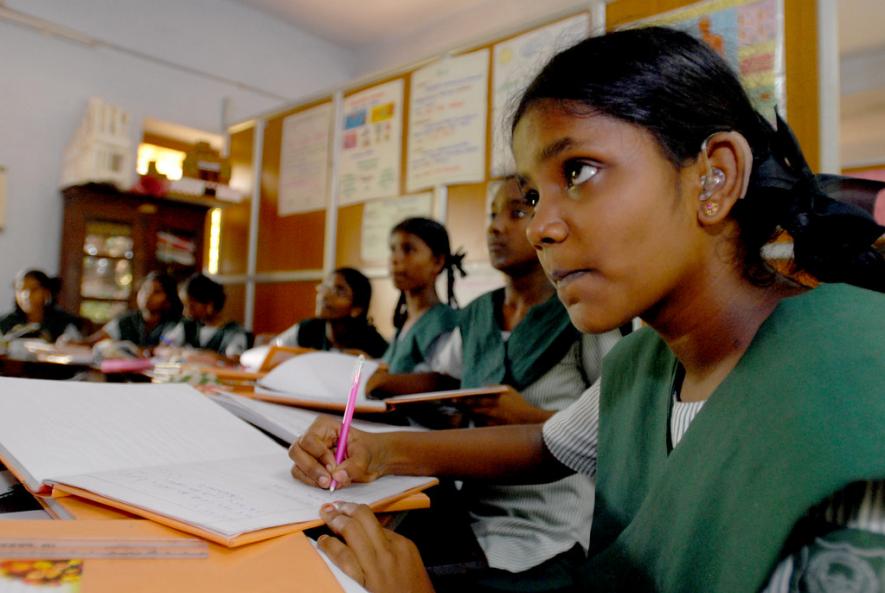
Representational Image. File Image
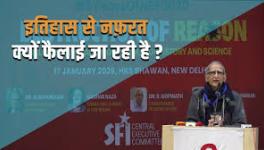
New Delhi: The packed auditorium at Harkishen Singh Surjeet Bhawan in New Delhi with students, mainly from North India, spoke volumes about their deep concern over the systemic changes in education that would affect their future.
The occasion was an all-India seminar on “Distortion of History and Science”, organised by the Students’ Federation of India (SFI) on the completion of five years of New Education Policy or NEP.
NewsClick spoke with many students who unanimously felt the NEP had accelerated exclusion of the marginalised sections from school and higher education at the grass-root levels.
Shaheen Afroz, a class XII student from North East Delhi, said the content of NCERT textbooks had been “cut irrationally and arbitrarily leaving students gasping for clues”. “In our text book on World Politics, the chapters on the Cold War era and US hegemony have been deleted. Teachers do not even tell us about it. So, the understanding of the world that we get is only a partial view.”
Vivek, a Master’s student from Himachal Pradesh, told NewsClick that the draft of the NEP was brought with the promise of making education egalitarian and inclusive. “However, we are witnessing a contrary trend. During the period of 2014-2025 over 90,000 schools were shut and merged. In my state, Himachal Pradesh, alone, the government has shut 818 schools and merged 535 schools in last three years,” he said.
His friend, Pawan, said that universities were going for fee hikes whereas family incomes were consistently declining. “Pollution and climate change has hit apple farmers hard. Our incomes are dropping. However, the Himachal Pradesh University Executive Council adopted a resolution to increase fees by 10% annually,” he added.
Addressing the seminar, well-known scientist and poet Gauhar Raza pointed out that the assault on reason and scientific temper began in the first month after Prime Minister Narendra Modi took oath (in 2014) to protect the Constitution. “When the Prime Minister of the world's largest democracy said in a conference of doctors in Bombay that Ganesha is a proof of plastic surgery…And after this, we saw that one after another, ministers, MPs, Chief Ministers and even judges…. continuously started attacking rationality. We were told that we had a plane that used to go up, down, right, left, and was also interstellar, i.e., it could reach other planets. We got to hear that our ancestors, and a minister is saying this, used to go to jungles a lot and they did not see any monkey becoming a man there. So, Darwinism should be removed.”
Raza said it was another matter that a very strong reaction came at the international level, “and for the first time, three academies from India’s scientific community together expressed strong opposition to it, so the minister was removed but Darwinism was also removed from NCERT textbooks.”
Raza further said that the Department of Science and Technology started arranging money for Panchgavya in a different way so that research could be done on Panchgavya, i.e., on cow urine, cow dung, milk, curd, and ghee.
“Just last week, we came to know that at one place there was a project of Rs 3.5 crore, out of which Rs 1.9 crore were spent on cow urine and cow dung. And the rest of the money was spent on luxury cars and a lot of furniture,” adding that “just think that this is in a country where modern chemistry started almost 100 years ago, and we call P.C. Ray the ‘Father of Chemistry’ in India. There is a lab at every crossroad in this country that tests your urine…if a doctor has written that get your urine tested, bring the report, you will get it by evening. And you are saying that we don't know anything about cow urine and need Rs 3 crore for research on it. It's a matter of shame.”
Raza pointed out that whether it is Department of Bio-technology or DST, India’s overall research budget is about .5% of GDP (gross domestic product). “This is being cut further. This budget is being diverted toward pseudo-science. This is an attack on the desire of the next generations to study science because when the budget is cut here, its impact will be on the institutions.”
Pointing to tremendous reduction in enrolment of students in the country, Raza said: “The number of children who study in schools till class 12th was 26.5 crore in 2021, now they have reduced to 24 crore, i.e., 2 crore less. From 2021 till now, 2 crore children have left school, which means almost around 1% if the total population of India is taken. If the population of children is taken, then there is a reduction of 8%. If 8% of children in any country stop going to school, then there should be a hue and cry because this is a question for the next generations. But we don't see any hue and cry, the media is silent on this. “
He said the report published by Unified District Information System for Education, which gives data every year, said one reason for this could be the reduction in birth rate, probably due to rising migration. Or, one reason could be education shifting from public to private sector.” At no place are they saying that almost 1 lakh schools were closed for this reason, that's why this reduction came,” he added.
Historian Ruchika Sharma pointed out four dangerous trends in education -- of biased portrayal of Muslim rulers, incomplete history of temple destruction, erasure of caste and communalism and manipulation of scientific evidence in the redesigning of NCERT textbooks.
“First, there's a very interesting quote from the NEP in the Class 8 social science textbook: "The aim is to enhance the students' analytical capabilities." This essentially means that students should be able to scrutinise and analyse what they are being taught. But if you read the text, you'll find that the exact opposite is happening. How will you give students analytical capabilities when you've already decided who was the villain and who was the hero in Indian history? You're giving value judgments yourself, claiming that all the Sultans and Mughal rulers were bad, brutal, and cruel,” she added.
Charging NCERT for manipulating books with preconceived notions, she said: “You've already introduced the term "Dark Age." What does "Dark Age" mean? There is no description. Students are simply told that the era of Sultans and Mughals was the Dark Age.”
Sharma questioned: “Where this term comes from is very interesting. Technically, it was used for the Middle Ages in European history. But academics discarded it long ago because it implies that nothing good was happening during that period. There has never been a period in human history without progress. Therefore, this term was considered ahistorical and abandoned by scholars. But NCERT isn't borrowing from European historiography. If you read (VD) Savarkar, the term comes from there. According to his framework, there is first the Golden Age—Ancient India before the arrival of Shakas and Hunas, the Aryan age, and then comes the Dark Age, which starts with the Shakas and Hunas. Why? Because according to Savarkar, the ideal of non-violence is a bad, effeminate ideal that weakens our civilisation. So, the Dark Age began from there.”
She said according to Savarkar (a Hindutva icon), “Buddhism is not very good because it brought the ideal of non-violence. In his view, the nation should be hyper-masculine. Ironically, it was the ideal of non-violence that brought us Independence.”
Sharma went on to add: "Look at the Class 6, 7, and 8 books—only the Class 8 book mentions temple destruction... It's not just that NCERT wants to show that only Mughals and Sultans destroyed temples. When the chapter on Marathas comes, they've removed the fact that the Marathas were responsible for significant looting. Look at the Shringeri Math temple. Between 1790 and 1792, Parshuram Bhau's forces destroyed it. They destroyed the large idol of Sharadamba (Saraswati) there and looted at least Rs 60 lakh —at that time. A letter went from the Maratha Peshwa asking what they had done and demanding the money be returned, but it never was. Who returned the money? Tipu Sultan. Tipu Sultan rebuilt that temple and the idol of Sharadamba. It's documented in a letter to Sachidananda Bharti, who was the Jagadguru of Shringeri Math at that time. All of this was removed from the textbooks. Before that, between 1770 and 1772, the Kudli Swami Math was looted by the Marathas—that was also removed. The temples of Melukote were burnt for iron—that was also removed.”
Invoking Hungarian philosopher Georg Lukács's work, The Destruction of Reason (1952), which argued that abandoning rational, scientific thinking creates a fertile ground for fascist ideologies, R. Gopinath, former Member Secretary of Indian Council of Historical Research and a long-time history teacher at Jamia Millia Islamia, said the shift in Indian education began in the 1990s with three concurrent developments: the Mandal agitation, Babri Masjid demolition, and Soviet collapse. “Neoliberal policies under Narasimha Rao weakened organised labour and public institutions, redirecting political focus toward identity politics centred on caste and religion,” he said.
Gopinath added that the NEP emphasises "heritage pride" and eliminating "colonial distortions" while mandating the "Indian Knowledge System" course. This curriculum privileges Vedic texts uncritically, ignoring India's diverse philosophical traditions and bypassing academic methodology. “Genuine historians have been removed from institutions like ICHR and replaced with ideologically aligned figures. Through legislation like the Vikshit Bharat Shiksha Adhisthan Bill, the government seeks centralised control over state universities, enabling enforcement of its historical narrative nationwide,” he added.
Social activist, Prof Ram Punyani, called upon students to organise and struggle. “We are in the world to build a better society, and where there is an atmosphere of hatred, there can be no progress. There can be claims of progress—anyone can make claims—but there can be no real progress.”
Get the latest reports & analysis with people's perspective on Protests, movements & deep analytical videos, discussions of the current affairs in your Telegram app. Subscribe to NewsClick's Telegram channel & get Real-Time updates on stories, as they get published on our website.